The landing page is part of the media buy
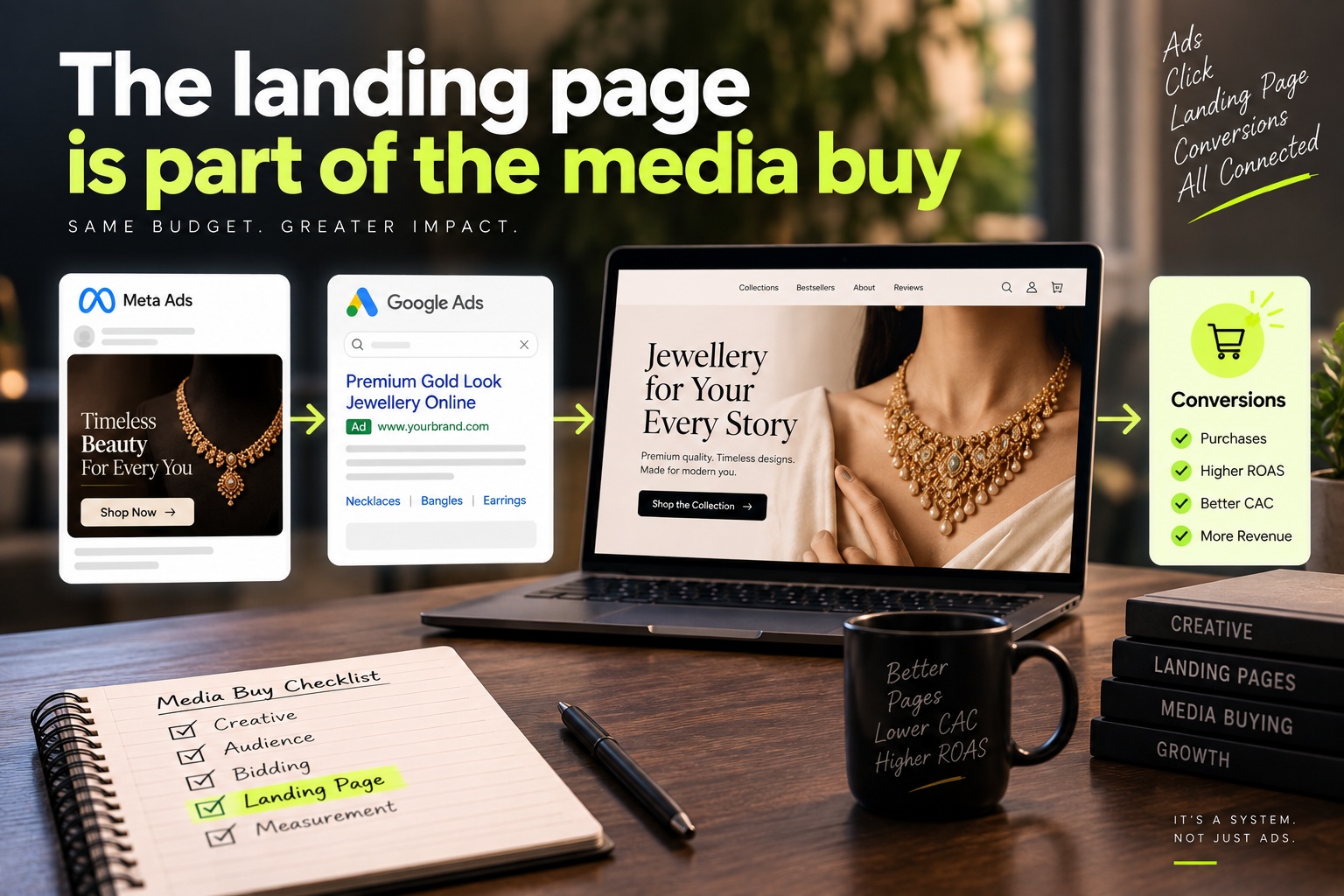
Media and landing pages are usually owned by different people, briefed separately, and reported on in different dashboards — which is exactly why the handoff between them is where so much spend quietly leaks. A campaign can hit every media benchmark — strong CTR, healthy CPM, a cost per click well inside target — and still convert badly, because the page the click lands on was built for a different intent, a different offer, or a different visitor than the ad actually sent.
Treat the landing page as a campaign variable, tested and iterated with the same discipline as an ad set, and the economics of the whole funnel change — often more than another round of bid optimisation would.
01 — Message match is the first filter. A visitor who clicked an ad promising 20% off a specific product expects to land on that product, at that price, immediately — not a generic homepage they have to search from. Every mismatch between ad promise and page content costs conversions before the visitor reads a word of copy.
02 — One page, one intent. A page trying to serve cold-traffic education and warm-traffic purchase intent at once usually serves neither well. Campaign-specific pages built for a single intent — and a single next action — convert meaningfully better than a shared, general-purpose page asked to do everything.
03 — Load speed is a media metric, not an IT ticket. A page that takes four seconds to load on mobile data loses a meaningful share of paid visitors before it ever renders — spend that was already paid for and never had a chance to convert. Page speed sits inside the media budget's return, whether or not the media team controls it.
04 — Qualification belongs on the page, not on the sales call. Forms that ask about budget, timeline or fit up front filter out visitors sales cannot convert, before they consume sales time. A page optimised purely for form-fill volume, with no qualification, often produces more leads and less revenue.
05 — The offer is a bigger lever than the layout. Before redesigning a page, test the offer itself — payment terms, risk reversal, bundling — against the same layout. Offer changes frequently move conversion rate further than a visual redesign, at a fraction of the production cost.
"If the media team cannot change the page, they are only ever optimising half the funnel." — how we frame it with clients.
What to do instead: build campaign-specific landing pages for any spend level that justifies the production cost, and treat them as part of the media budget rather than a separate web project. Audit message match between ad and page before touching bids. Test the offer before the layout. And put page speed on the same weekly reporting cadence as CPC and CTR — a slow page is a media inefficiency with a different name.