Setting a target CAC you can actually defend
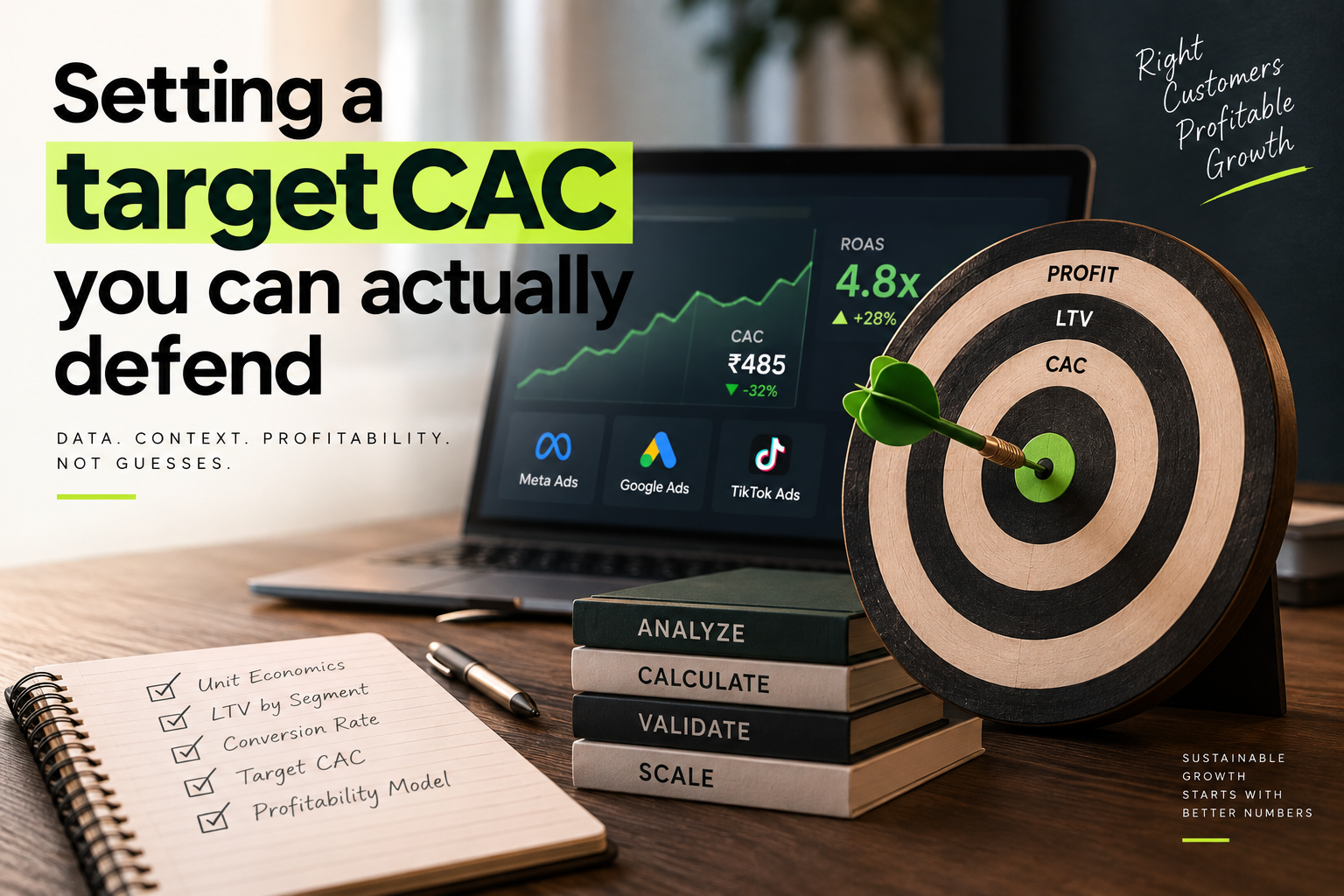
Ask five marketers for a "good" CAC and you will get five different numbers, usually copied from a case study in a different category, at a different price point, with different margins. A defensible target CAC has nothing to do with what a competitor claims and everything to do with three numbers already sitting in the business's own P&L: contribution margin, payback tolerance, and repeat-purchase behaviour.
Start with contribution margin, not revenue. Take average order value, subtract cost of goods, payment gateway fees, fulfilment and returns, and whatever variable cost the sale carries before it reaches gross margin. That number — not AOV — is what a customer is actually worth on day one. A ₹4,000 order with 35% contribution margin leaves ₹1,400 to fund acquisition, service cost and profit. Any CAC target built on the ₹4,000 figure is fiction.
Next, decide the payback window the business can tolerate. A founder with twelve months of runway and a business that needs to prove unit economics this quarter cannot afford the same payback period as a funded brand playing a three-year game. Payback period — not "what looks competitive" — is the actual constraint. If the business needs cash back within 60 days, target CAC should sit comfortably inside first-order contribution margin, full stop. Anything beyond that is a bet on repeat purchase the business may not survive long enough to collect.
Then bring in repeat-purchase behaviour, honestly. If historical data shows a customer places 1.8 orders on average within twelve months, target CAC can reasonably stretch beyond first-order contribution margin — but only by a defensible fraction of that repeat value, not by the full LTV number a deck likes to quote. LTV projections three years out are marketing, not underwriting. Use trailing twelve-month repeat behaviour from your own CRM or store, not an assumption.
01 — Contribution margin sets the floor. CAC above it means every sale loses money on day one, funded entirely by a bet on repeat purchase.
02 — Payback tolerance sets the ceiling. A business that needs cash back in 60-90 days cannot run the same target as one with a longer runway, regardless of category benchmarks.
03 — Trailing repeat data — not LTV projections — is what justifies spending above first-order margin, and only up to a fraction of proven, not hoped-for, repeat value.
04 — Blended CAC hides channel-level truth. A blended target across Meta, Google and referral obscures which channel is actually profitable and which is being subsidised by the others. Set the target per channel where volume allows.
"A target CAC that cannot survive being said out loud to your CFO was never a target — it was a hope." — how we frame it with clients.
What to do instead: pull contribution margin per order from actual cost data, not a rough estimate. Decide the payback window the business needs based on cash position, not category convention. Pull trailing twelve-month repeat-purchase rate from your own CRM or store data before stretching CAC beyond first-order margin. Set targets per channel once volume supports it, and revisit the number quarterly as margin, repeat rate and cash position shift — a target CAC set once and left unexamined for a year is already wrong by month three.